

Why Text to Video Has Become the Marketer's Most Valuable AI Skill
Jenny
The ability to turn a written idea directly into a finished video clip is one of those capabilities that sounds like science fiction until you actually use it in a real workflow. Text-to-video generation has matured rapidly over the past eighteen months, and in 2026 it sits firmly in the category of practical production tools rather than experimental technology.
For marketers, creators, and small business owners, the implications are significant. Video content drives more engagement, more conversions, and more algorithmic reach than almost any other format across every major platform. The barrier has always been production — the time, equipment, and expertise required to go from a written concept to a finished video clip. Text-to-video AI removes that barrier in a way that's now genuinely usable for professional output, not just rough prototypes.
Understanding which platform gives you the best combination of model quality, workflow integration, and creative control is where the real decision-making happens.
What Makes Pollo AI's Text to Video Generator Stand Out
Not all text-to-video tools are built the same way. Some platforms lock you into a single generation model, which means your output quality is capped by whatever that model does well — and constrained by everything it doesn't. Pollo AI takes a different architectural approach.
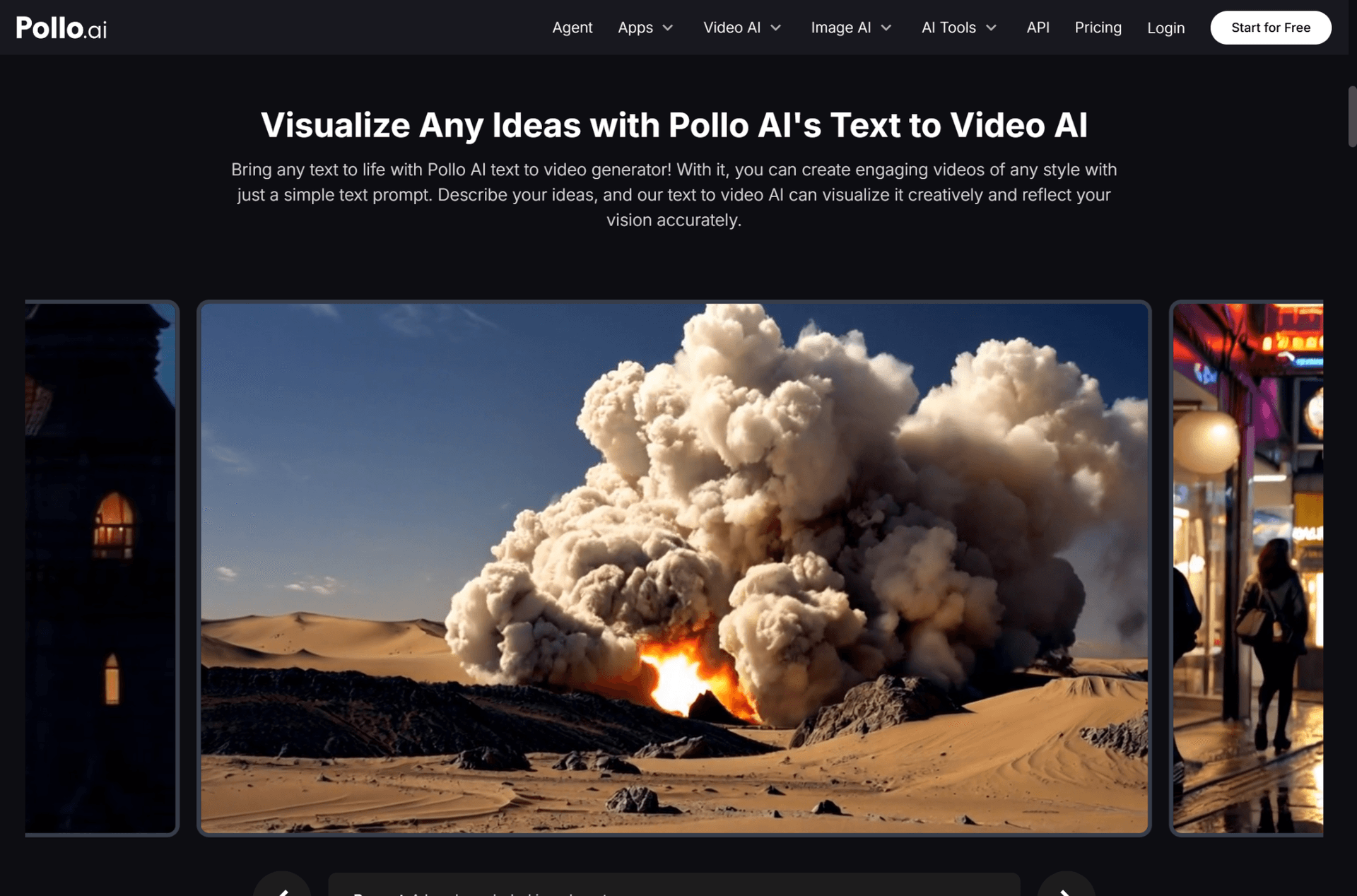
The Pollo AI text to video generator inside its Creative Studio aggregates multiple leading generation models under one interface, with a shared credit system that lets you switch between them based on the specific output you need. One model might produce stronger cinematic motion, another might handle character animation more naturally, another might excel at abstract or stylized visual work. Rather than working around a single tool's limitations, you're selecting the right model for each project.
For creators who produce across different content styles — brand videos, social content, educational clips, creative experiments — that flexibility translates directly into better output across a wider range of projects. Pollo AI's Creative Studio also connects image generation, video generation, and audio within the same environment, so a complete content production workflow can happen without switching platforms.
Writing Prompts That Actually Produce Good Video
The quality gap between a mediocre text-to-video output and a genuinely usable one often comes down to how the prompt is written. The model needs enough information to make good decisions about composition, motion, pacing, and visual style — and vague prompts produce vague results.
A few principles that consistently improve output quality: describe the camera behavior explicitly rather than leaving it to interpretation. "Slow push in on a product placed on a marble surface, soft studio lighting" will produce a more controlled result than "a product on a table." Include mood and atmosphere alongside the literal subject. Specify what you want the motion to feel like — dynamic and fast-paced, or slow and contemplative — because the model will make that choice itself if you don't.
For marketing content specifically, front-loading the visual action matters. Text-to-video outputs that save the interesting motion for the middle of the clip perform worse on social platforms than those that establish visual interest in the first two seconds. Write your prompts with that in mind — describe what's happening at the start of the clip, not just what the scene contains.
Marketing Studio: When Text to Video Needs to Convert
There's a meaningful difference between generating video content and generating video content that performs in a paid or organic marketing context. Pollo AI's Marketing Studio addresses this distinction directly. It's built for marketers, brand teams, and creative agencies producing advertising and promotional video at volume — social ads, product demos, branded content — where the output needs to meet platform specs and drive action, not just look visually interesting.
The studio positions Pollo AI alongside dedicated marketing video tools like Creatify and Topview, but within an integrated environment where your text-to-video workflow connects directly to your image assets, audio generation, and commerce photography. For SMBs running their own marketing without a production team, that integration means the distance between a written campaign concept and a publishable video ad is genuinely short.
Vidfly AI and Knowing the Competitive Landscape
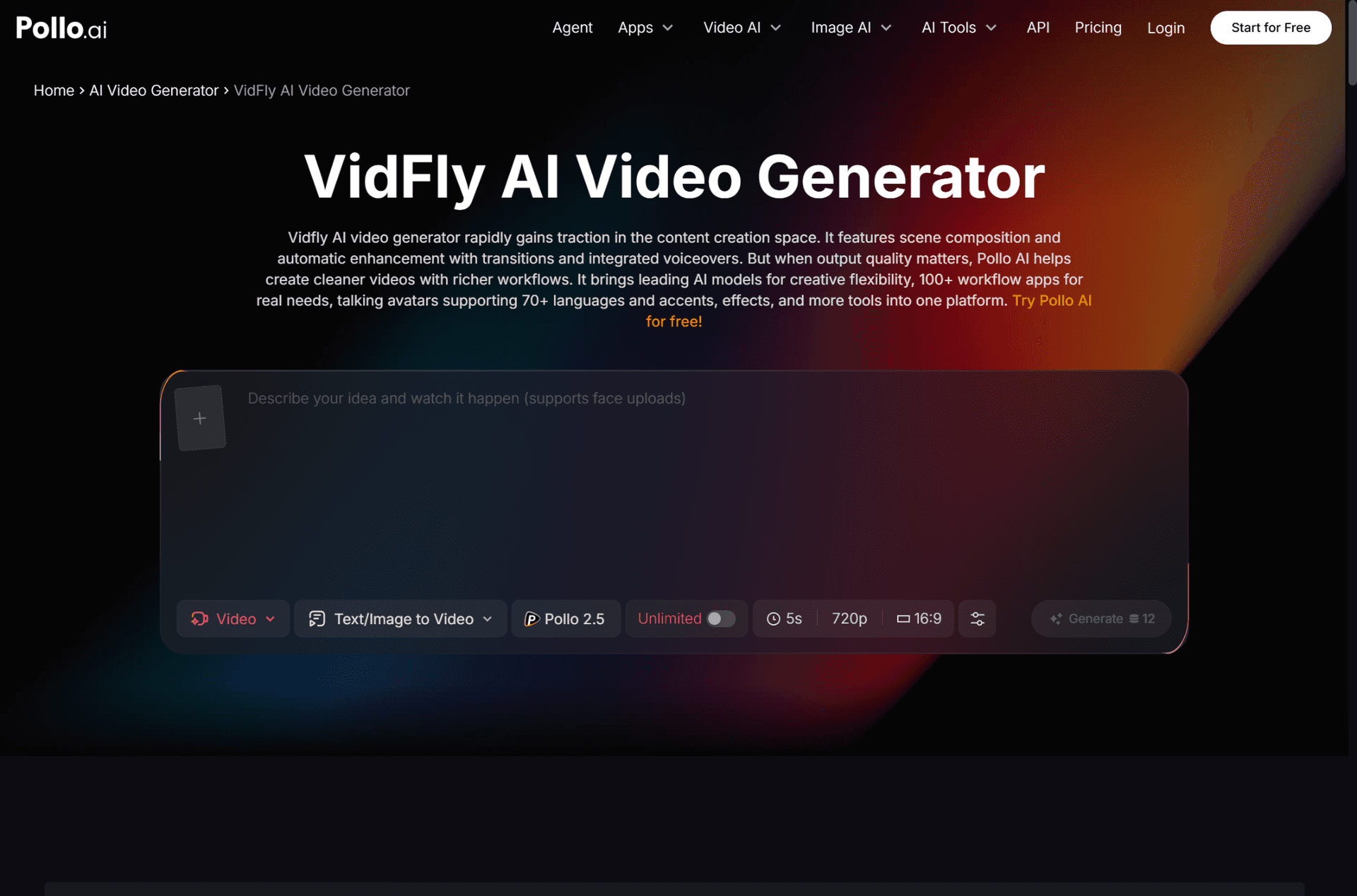
Understanding where different tools sit in the ecosystem helps you make better decisions about where to invest your workflow. Vidfly AI is a platform worth knowing in the text-to-video space, with its own approach to AI video generation that suits certain content types and workflows. Evaluating tools side by side — understanding their specific strengths, output styles, and workflow fit — is the kind of research that pays off over time.
Pollo AI's differentiation in this landscape comes from breadth and integration. Where many tools specialize in one output type or one generation model, Pollo AI's multi-studio structure covers the full range of visual content production — creative video, marketing video, product imagery, and design — under one account. For teams whose content needs span more than one of those categories, consolidation has real practical and financial value.
Building a Text to Video Workflow That Scales
The creators and marketing teams getting the most out of text-to-video generation in 2026 aren't using it for one-off experiments. They're building repeatable workflows where AI handles the production layer while human effort focuses on strategy, messaging, and creative direction.
A scalable text-to-video workflow typically looks something like this: develop a clear content brief with specific visual objectives, write structured prompts that describe composition and motion explicitly, generate multiple variations and select the strongest output, add any brand elements or captions in post, and publish natively to each platform. That cycle — which used to represent days of production work — can now happen within a single session for most content types.
Pollo AI's structure supports this kind of workflow end to end. The shared credit system means you're not managing separate budgets for image and video generation. The multi-model environment means you're not capped by a single tool's output quality. And the dedicated studios mean your creative, marketing, and commerce content pipelines all connect rather than operating as separate silos.
For anyone serious about video content production in 2026, getting comfortable with text-to-video generation isn't optional anymore — it's a baseline skill. The question is which platform gives you the right combination of quality, flexibility, and workflow integration to make it a genuine production asset rather than just another tool to manage.